Tuesday, 20 December 2016

more small steps

Once I have a few bolts glued in place I can measure the distance between the bolts and start designing the frame. Of course, I could measure the shrinkage of clay and try to work it out mathematically instead, but this is much safer option.


 It is really important to get distances and angles right, or nothing will fit together.


Looks about right. Now I can do the cutting list and chop 60 m of flats into small bits. FUN!!

Tuesday, 13 December 2016

small steps

The tile production is going smoothly,so it is time to start thinking about the next step: fixing the bolts in the holes at the back of the tiles.
I know that it sounds simple: you glue them in, right? 
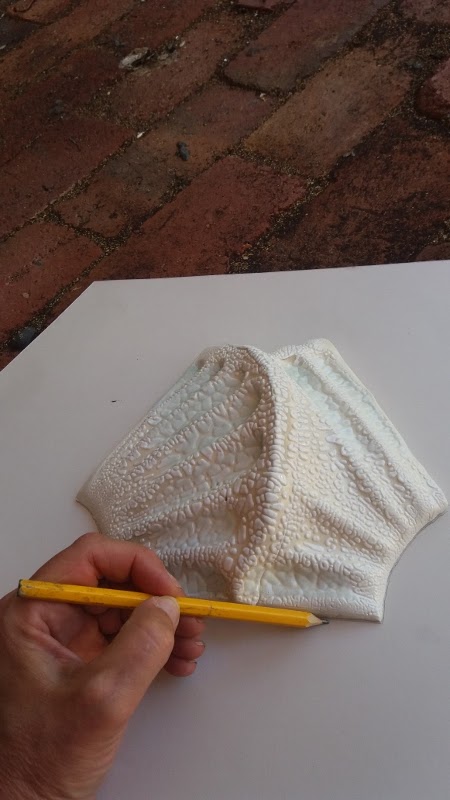
There are a few things that need to be considered. Without some sort of support the bolts will not stand straight (as you can see on the left):


Previously I had 3 bolts per tile and a simple template with 3 holes was enough to keep them where I wanted them to be. With 2 bolts per tile the situation changes as they can still topple forward:


After a few ( a good FEW) trials and errors I have settled on this template:

That will keep them in place! 
Well, that took the whole morning. I'm using recycled aluminium printing plates for making templates.Now I need to cut about 25 of them, and precisely drill the 4 holes in each one.  That will take care of the afternoon.

Tuesday, 6 December 2016

the third project

The third project is very different. I am making objects that are reminiscent of Victorian European ceramic, yet decayed and malformed.
It is a great project, very different from what I normally make and I'm thoroughly enjoining it.
You would not believe how difficult it is to make malformed pots!!! I'm throwing them on a potters wheel, which doesn't take kindly to uncentered clay,  but than my instincts are to smooth, even out and perfect. Which is quite strange as I don't usually strive for those qualities. All of the sudden, with coil throwing larger vessels, I am transported right back to the student days at art school...and I have to very consciously move away from it.
The thing is, although objects are meant to be decayed and malformed, I still want them to have a beauty within them.
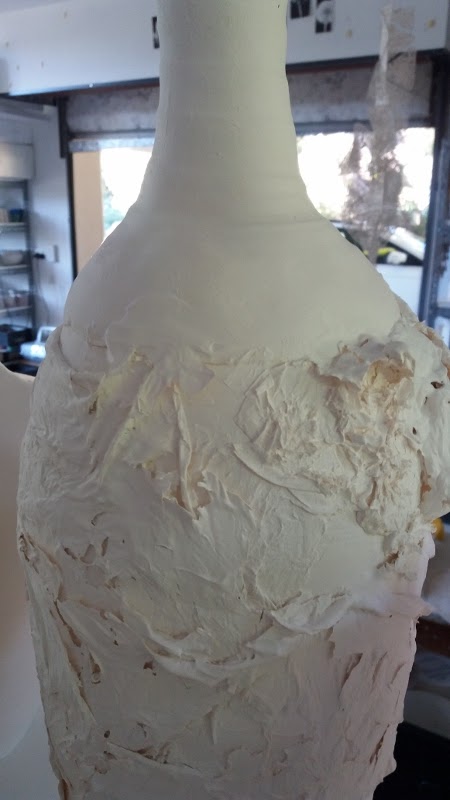
Here are some bisque fired surfaces:


And some drying:

And some that didn't make it:

I was going to keep it, but by the afternoon the whole top has collapsed inside the vessel.
So I went and bought a new hose for my gas bottle blow torch. I haven't used one of them for a while. It certainly speeds the drying process!!

Wednesday, 30 November 2016

In the Grain of Sand

At the moment I’m working on 3 interesting projects. 
Producing 220 tiles for the large sculpture has a nice rhythm of making, drying and firing, and I don't want to think about the next step - making the frame.
The sculpture is/will be titled: In the Grain of Sand. 
I don't really like naming the work before it is made as it could possibly restrict the growth of the idea, but in this case it was necessary.
It continues my exploration of the infinitely small, microscopic and, in this case, fragmented; and at the same time evokes ideas of complexity of the universe, individuality, fragmentation, decomposition and questions of origin. All of it in the grain of sand.


With 220 tiles in the making, the space in the studio is becoming limited
finished tiles:
It will be interesting to see how it all comes together. 

Second project is connected to the first: the Grain of Sand Studies.
I am enlarging imaginary fragments - grains of sand and exploring the shapes and textures.
I'm using terracotta, stoneware and porcelain clays as well as sand. Needless to say that those materials all behave differently and I have no idea if they will stay together through the drying and firing process. First tests have just come out of the firing and I'm happy with the results: colour of terracotta is nice dark chocolate brown, and it stayed together with the other clay. Yay.
Now I have to be very patient and allow the works to dry thoroughly before firing them. Not being familiar with terracotta, I can't just judge by the colour.
Here are a few photos of the works in progress:


Friday, 4 November 2016

Evolving

I have been away from the studio for 6 weeks, or was it longer? It seems a long time ago that I was feverishly working towards the solo show, and then packing up a suitcase and travelling for a month.  
This week, I’m back and making.
It is “another big one”. Every big sculpture I make has some known elements and some new ones, and it takes me few steps further into the unknown. This sculpture is not based on the geodesic dome. It is based on geometric shape called rhombic triacontahedron. It consists of 30 rhomboids, and it looks something like this:


Why this particular shape? It feels right. Not too simple and not too complex. And although this particular shape is not found in nature (that I’m aware of) it resonates with the natural forms through the idea of faceted sphere.
Could it "feel right" because the lengths of the diagonals are in the golden ratio?


This is the concept drawing of the sculpture that I'm making:

It will be made from 220 identical 3d tessellated tiles. Although the sculpture's skeleton is a 3d geometric shape, I want the finished sculpture to be organic and intuitively accepted as natural.

Tuesday, 11 October 2016

Travels

It has been over 2 months of blog silence. The exhibition has been packed away and shortly afterwards we have packed our bags and ventured on a month long trip to the USA and Canada. Right now I’m talking to you from beautiful Quebec. This travels are primarily a family holiday, and a sensory overload of sights, sounds and flavours from New York to New Orleans and beyond. Studio is far away from mind and body, although I can’t help (occasionally) wondering if and how will this experience influence what I make.

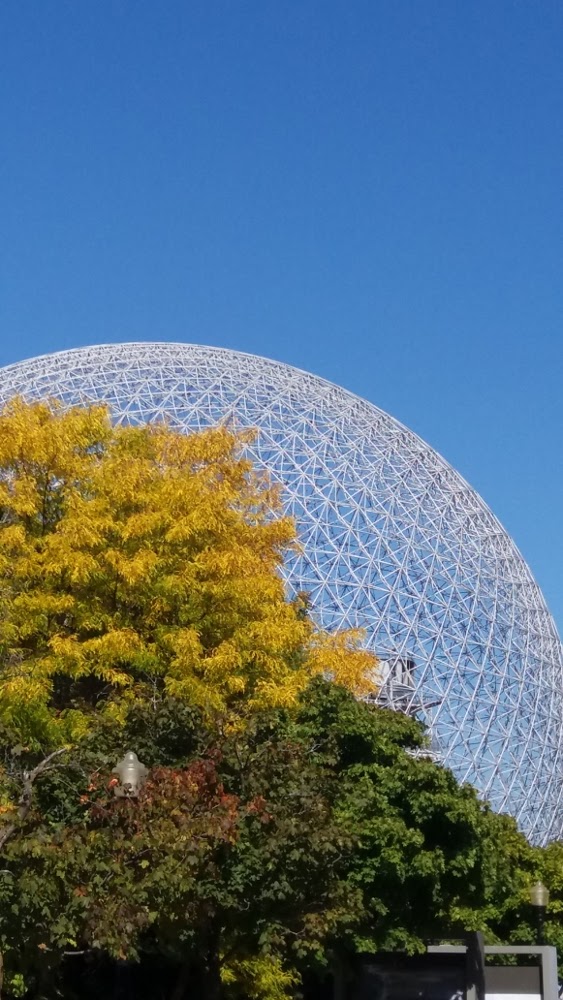
This is a Biosphere in Montreal, most amazing example of geodesic dome I have ever seen:


With trees within, outside...


...and plants slowly taking over:
love it!!

Thursday, 4 August 2016

Standing at Water's Edge - catalogue essay


Standing at water’s edge…
Does it evoke the image of waves gently caressing the shore, sun glittering on the surface, and rhythmical sounds of the ocean breathing in and out?
Or dark and deep angry waters powerfully crashing onto the shore with relentless energy and thunderous sounds, goaded by the wind?
Do you ever think of it as the border of the realm we belong to and the one we can only visit for a short time. Fascinating, Intriguing, Inviting?
I am drawn to the big bodies of water, as many of us are. I like standing at the water’s edge, listening to the rhythmical breathing of the waves. I can spend hours pondering and meditating, acutely aware of the vastness of the ocean and another world hiding under the surface. World within world. Divided or connected by the membrane separating water from air. Sometimes, the connection I feel is so deep that I am acutely aware of the origin of life. My cells used to belong to the ocean. I can feel the tides in my body. I belong.
It is an immersive, intense and short lived experience.
I try to capture and communicate that experience through the objects I make. I don’t have words for those thoughts, so I am exploring them through making the objects that speak of them, that allow me to glimpse the holistic nature of our universe and our being in it.
I look at many natural forms and learn from them.
Planktons, pollens, microscopic images of insects and butterfly eggs.....
There is such diversity, rhythm and playfulness of form in those tiny objects, but what intrigues me the most is the abundance of the little individual variations, complexity of the form and their beauty.
To me, those forms symbolize life. Life as significant as mine. Fragile and strong. Unique and universal.
Nature, of course, never makes straight lines or perfectly symmetrical curves. It grows forms in the seemingly spontaneous and playful, yet ordered and rhythmic way. I try to observe closely and grasp the essence of each form in order to create the visual symbols, language without words that will talk about life. Not human life. Universal life.
Using clay to express my ideas is a two way process. The choice of the material and techniques defines the forms I can make, and is defined by my ability to manipulate and understand the material I use. I love the feel, the smell, and the idea of using a natural, earthy, ancient material to explore and express thoughts. It is extremely pliable and responsive to the slightest touch, and at the same time often incapable of holding its own weight and very fragile when dry.
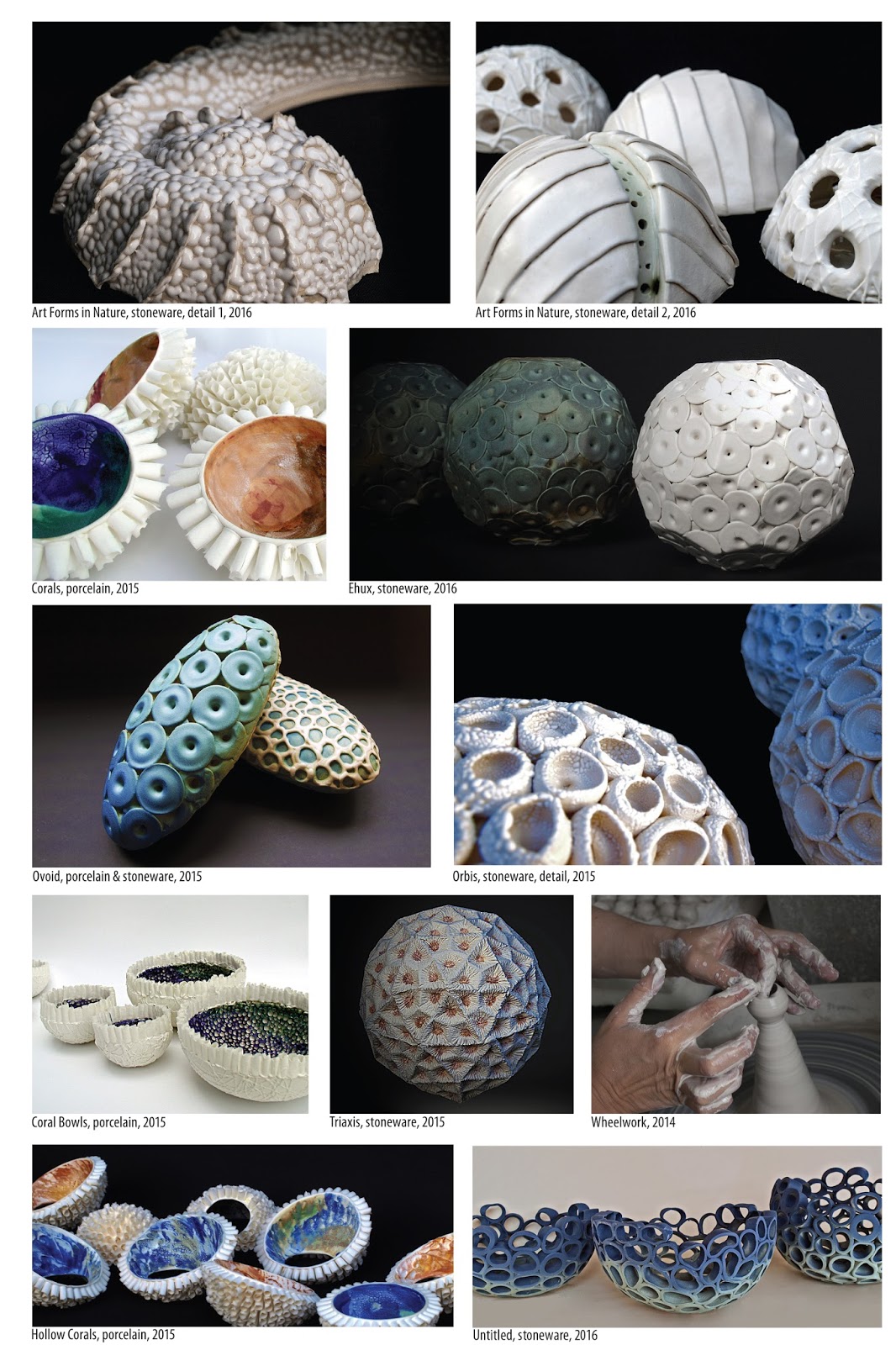
I use all the traditional forming techniques in making my work: handbuilding, press moulding, wheel throwing and slip casting; and many innovative, atypical ones. I like to think of my practice as a creative one, a synthesis that does not fit neatly into the preconceived boxes of art, craft and design, but moves freely across the fields.

“Everyone agrees that making art involves self-expression. However, I suggest that genuine creativity involves much more. It involves the artist immersing in the art form, which then invites the audience into that immersive space. Creativity reaches for connection.”*


*Dr. Anne Paris: Standing at Water's Edge: Moving Past Fear, Blocks, and Pitfalls to Discover the Power of Creative Immersion, New World Library, June 1, 2008